
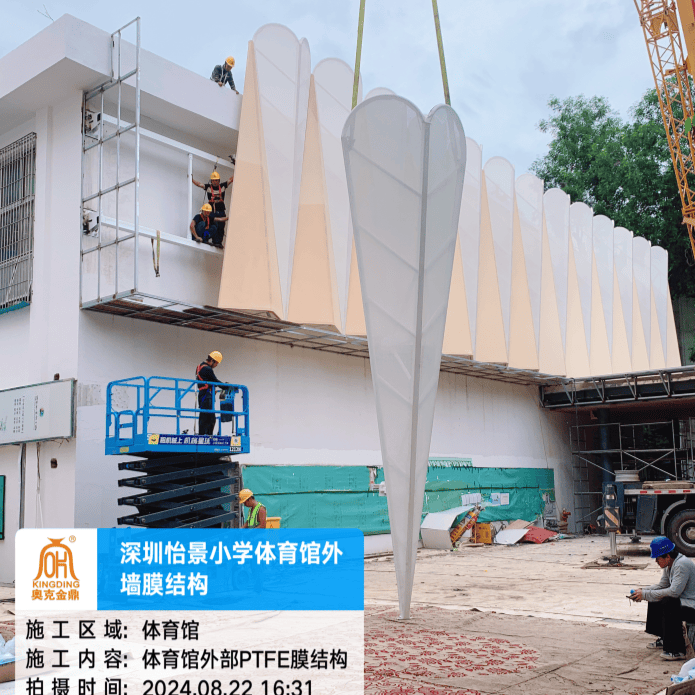
Membrane structure facade for gymnasium

EXW
¥800.00-1,800.00 /CNY/m²
中国广东省
笋岗路华通大厦1808
15816892011
在线沟通
收藏
产品介绍
The membrane structure is mainly composed of three parts:
1. Foundation:
On-site excavation for independent concrete foundations or post-installed embedment. Design is customized according to the specific project conditions.
2. Main Support Steel Structure:
Common structural forms include:
  • Truss Long-span Structure
  • Single-column Cantilever Structure
  • Integrated Artistic Shaping Structure
3. Covering Membrane Material:
Generally utilizes three types of architectural membrane materials:
  • PTFE Membrane
  • PVDF Membrane
  • ETFE Membrane
    (These materials serve the functions of rain protection, sun shielding, UV resistance, and space beautification).

📞 Contact Information

Brand: Qi Li Fang (Shenzhen Aoke Jinding)
Contact: Li Mingqiang
Mobile / WeChat: 0086 136 3155 7305
Email: mailto:463729889@qq.com
Factory Address: Suburban Inflatable Building, Shuixianbu Village, Lianghua Town, Huidong County, Huizhou City, Guangdong Province.
Company Address: Room 1808, Huatong Building, Songgang Road, Luohu District, Shenzhen, Guangdong Province.
Website: www.szokjd.com


Technical Parameters

PVDF (Polyvinylidene Fluoride) membranes are widely used in water treatment, biopharmaceutical separation, and industrial filtration, thanks to their excellent chemical stability, high mechanical strength, and superior processability. Their structural and technical parameters mainly encompass the following core dimensions:
1. Structural and Dimensional Parameters
PVDF membranes typically feature an asymmetric structure, consisting of a dense surface layer of about 0.1-1.0μm (responsible for physical sieving) and a support layer of about 1mm (ensuring mechanical strength).
Filtration Accuracy & Pore Size: The filtration accuracy generally ranges from 0.01 to 5.0μm. For high-performance membranes, the pore size can be precisely controlled around 20-50nm with a uniform distribution.
Molecular Weight Cut-Off (MWCO): The conventional MWCO ranges from 10 million to 80 million Daltons.
Porosity: Depending on the manufacturing process, the porosity can reach over 70%.
2. Mechanical Performance Parameters
PVDF membranes possess outstanding physical strength, capable of withstanding high operating pressures and tensile loads.
Tensile Strength: Generally ranges between 6-20 MPa. By incorporating reinforcement methods such as non-woven PET fabrics, the tensile strength can be increased to over 30 MPa.
Elongation at Break: Exhibits excellent toughness, with a maximum tensile strain exceeding 140%.
Operating Pressure: The conventional operating pressure is typically controlled between 0.1-0.25 MPa.
3. Chemical and Tolerance Parameters
Acid & Alkali Resistance: Features extreme corrosion resistance, capable of withstanding strong acidic and alkaline environments with a pH range of 1-14.
Temperature Resistance: The melting point of PVDF material is approximately 177℃. The conventional operating temperature range for the membrane is 4-45℃, and it can maintain structural stability under specific high-temperature conditions.
Solvent Resistance: Demonstrates excellent long-term stability against most organic solvents, halides, and oxidants.
4. Surface Characteristics & Flux
Hydrophilicity/Hydrophobicity: Pure PVDF material is inherently hydrophobic (with a water contact angle typically above 90°). To enhance anti-fouling capabilities, industrial applications often use hydrophilic modification processes to reduce the surface contact angle (to around 55°), significantly improving the membrane's anti-fouling and wetting resistance performance.
Water Flux: After hydrophilic modification, the water flux can be significantly increased, with some high-performance membranes reaching 1700-4200 L/m²·h.
Rejection Rate: In conventional filtration and membrane distillation applications, the rejection rate for specific pollutants (such as salts and water-in-oil emulsions) can be stably maintained at 95%-99.99%.